Dr. Liang Ding — Research Website
🔍 Selected Research Projects
Lithological Mapping and Uncertainty Quantification
• Lithological Mapping Using Aeromagnetic and Gravity Data,
• Swin Transformer–Based U-Shaped Network,
• Theoretical Analysis of Uncertainty Sources.

Ding, L., Bellefleur, G., Boulanger, O., & Vo, P. (2026). Supervised Swin Transformer-based predictive lithological mapping and uncertainty quantification using aeromagnetic and gravity data. Journal of Geophysical Research: Machine Learning and Computation, 3, e2025JH000882. https://doi.org/10.1029/2025JH000882
Read the full article →Seismic Data Denoising with Deep Learning
• Enhances seismic denoising through sparse-domain signal representations,
• Uses Swin Transformer blocks and self-attention without convolutional layers,
• Improves SNR across synthetic, vibroseis, and DAS VSP datasets,
• Examines challenges in recovering true STFT real and imaginary components.
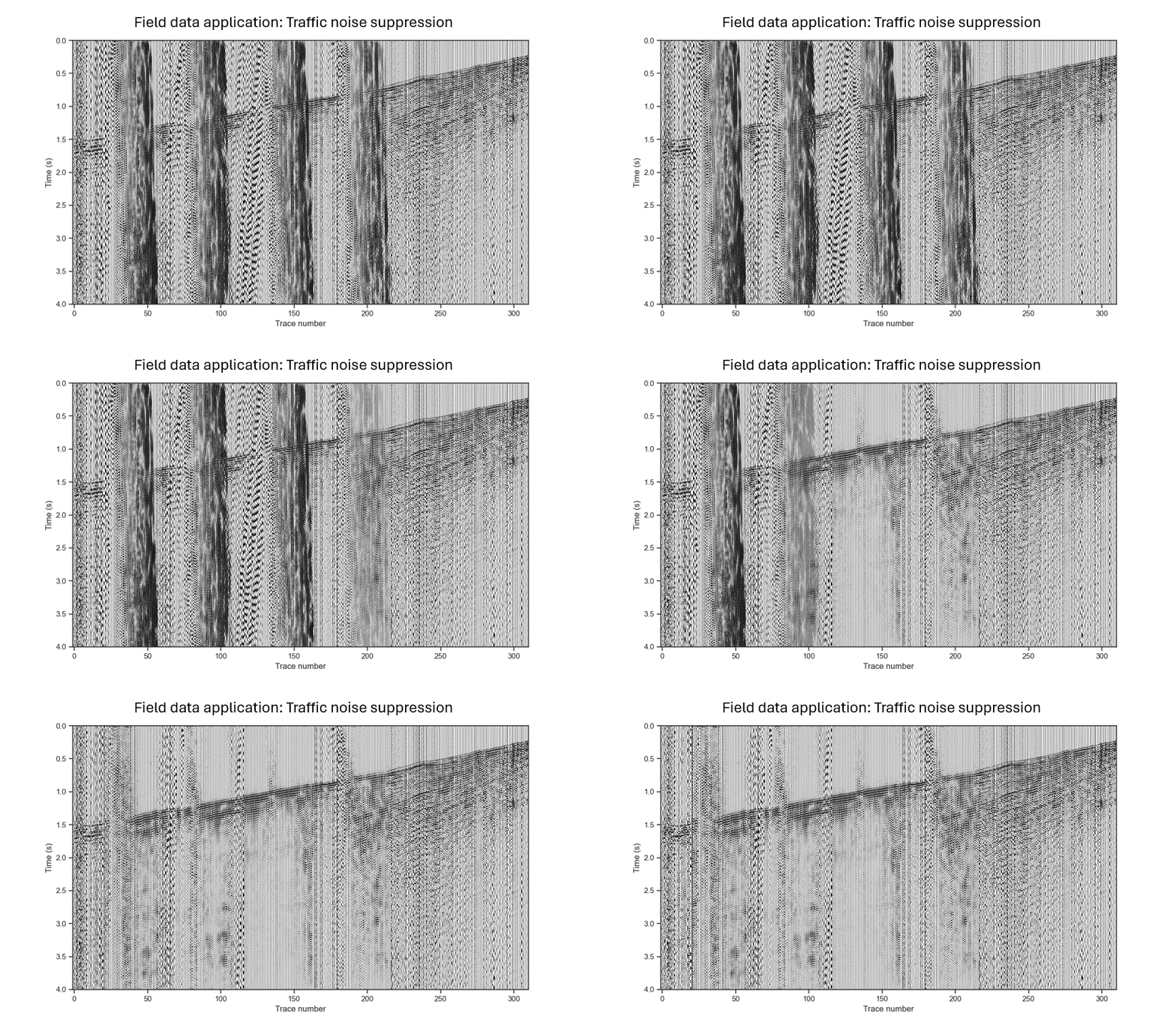
Ding, L., Bellefleur, G., & Cheraghi, S., (2026). Seismic Data Denoising in Sparse Representation Domains with a Swin Transformer-Based UNet. Journal of Applied Geophysics, 255, 106534. https://doi.org/10.1016/j.jappgeo.2026.106534
Read the full article →Earthquake Source Inversion
Improving seismic monitoring networks:
• Accurate source characterization using 3D background models
• Effective inversion using pre-computed 3D Greens function database
• Earthquake monitoring at regional and global networks

Triggering Mechanism of Earthquakes
Exploration of fault reactivation processes during hydraulic fracturing operations.
• Full moment tensors with uncertainties resolved using MTUQ.
• Foreshocks show +CLVD, indicating tensile opening linked to fluid injection processes.
• Aftershocks show +ISO and +CLVD, suggesting fluid migration and aseismic slip post-failure.

Ding, L., T. de Boer, M. H. Khosravi, G. Yang, E. Kravchinsky, S. K. Y. Lui, G. Grasselli, and Q. Liu (2026). Full moment tensor inversions of microseismic events revealing fault activation of the 17 August 2015 earthquake in the northern Montney Formation, British Columbia, Canada. Bulletin of the Seismological Society of America. https://doi.org/10.1785/0120250267
Read the full article →AE Sensor Array Optimization
Quantitative Optimization of Sensor Positions in Laboratory Acoustic Emission Experiments
• Optimized AE sensor arrays using the Tammes problem.
• Reduced moment-tensor inversion uncertainty.
• Improved sensor coverage and inversion stability.
Ding, L., Yang, G., Kravchinsky, E. et al. (2025). Quantitative Optimization of Sensor Positions in Laboratory Acoustic Emission Experiments. Rock Mechanics and Rock Engineering, 58(8), 9601–9613. https://doi.org/10.1007/s00603-025-04605-6
Read the full article →Moment Tensor Non-Uniqueness in AE Monitoring
Moment-Tensor Uncertainty From Sparse First-P Polarity Coverage in AE Monitoring
• Assessed MTI uncertainty using first-P polarity only.
• Sparse arrays increase non-uniqueness.
• ≥18 sensors greatly improve reliability.
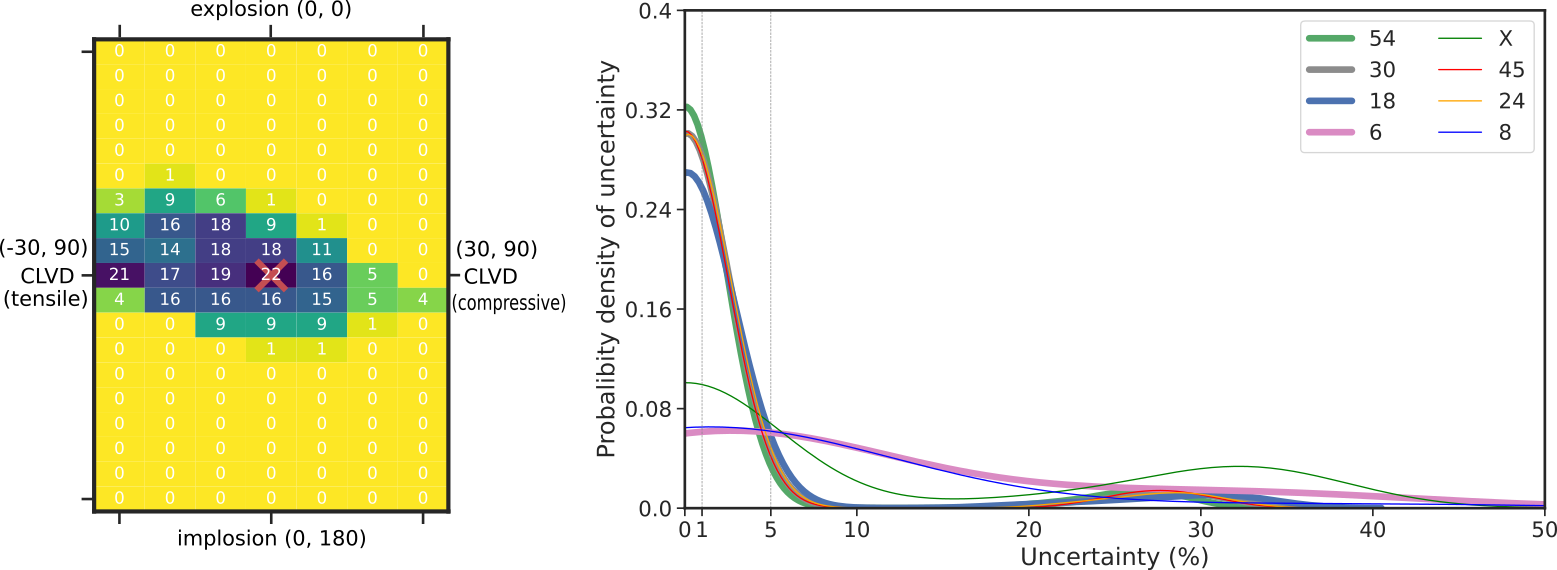
Ding, L., Yang, G., Kravchinsky, E., Popoola, A. K., Goodfellow, S., Liu, Q., & Grasselli, G. (2023). Systematic Uncertainty Quantification of First-Polarity-Based Moment Tensor Inversion Due to Sparse Coverage of Sensor Arrays in Laboratory Acoustic Emission Monitoring. Pure and Applied Geophysics, 180 (11), 3733-3752. https://doi.org/10.1007/s00024-023-03366-z
Read the full article →